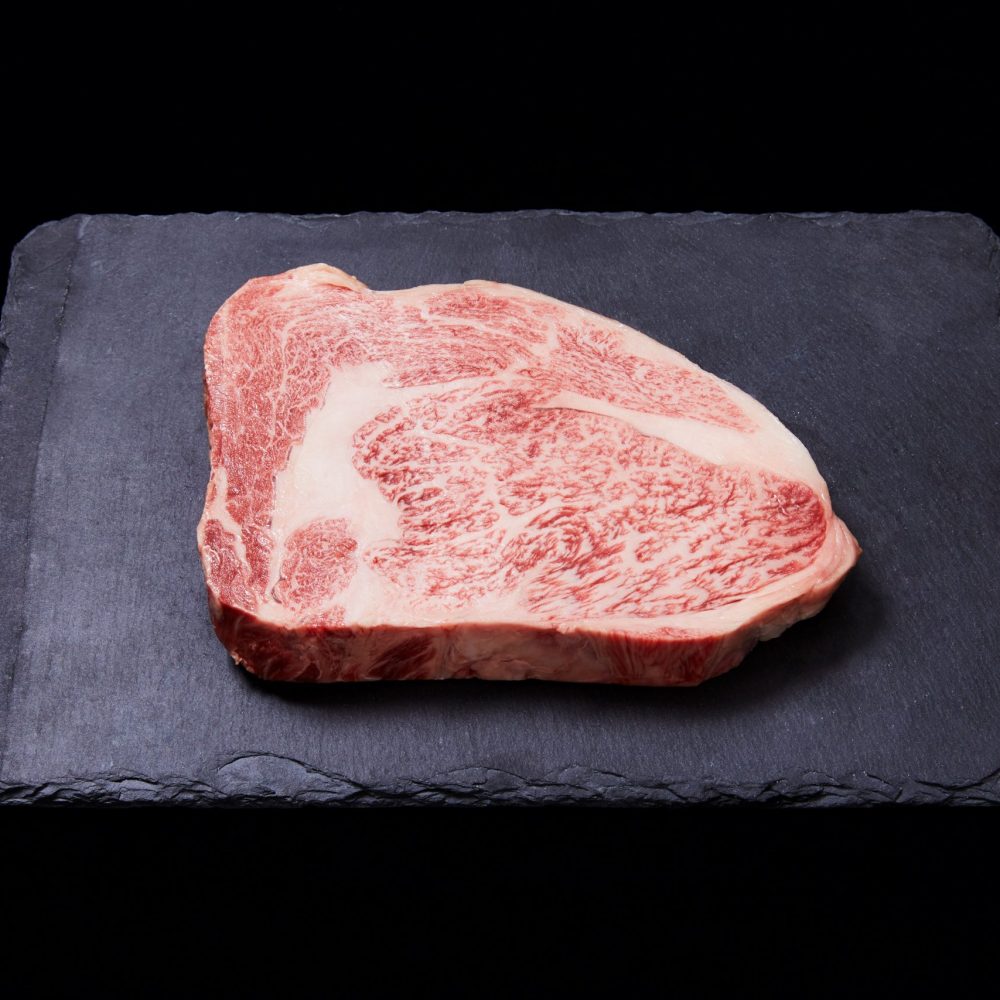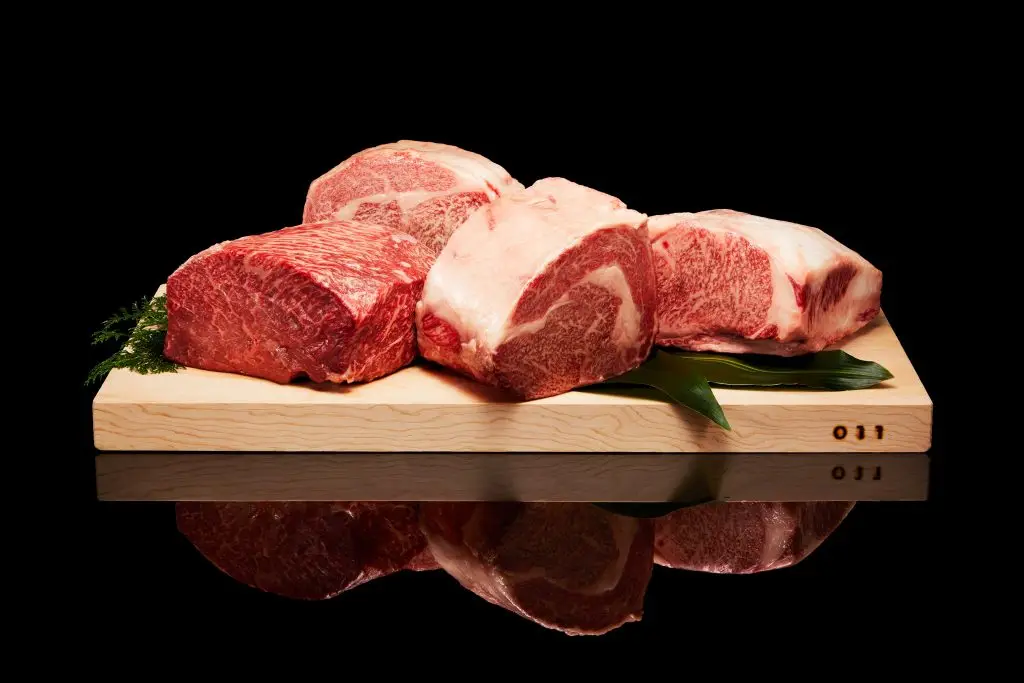
While many assume “Wagyu” refers to any beef from Japan, the label is actually protected by a strict legal framework.
True Wagyu refers exclusively to four specific cattle breeds developed over generations of meticulous selective breeding from native Japanese stock. Only these four strains—or specific crossbreeds between them—can legally carry the Wagyu label:
Japanese Black is the undisputed titan of the industry, making up 95% to 98% of all Wagyu in the market. When you hear of legendary names like Matsusaka or Kobe, you are almost always eating Japanese Black. The remaining three breeds are incredibly rare treasures: Japanese Brown accounts for just 1% to 2%, Shorthorn sits around 0.5% to 1%, and the ultra-rare Polled makes up a microscopic 0.01% of the population.
To shop like an expert, you must understand that Japanese beef operates on a clear three-tiered hierarchy:
The alphanumeric stamp on a piece of Wagyu is often misunderstood by consumers. The grade is determined by two completely independent metrics:
It is a common misconception that A5 guarantees the “best taste.” The grading scale is an assessment of visual perfection, not flavor. An A5 steak represents maximum marbling density—delivering a rich, buttery, melt-in-your-mouth experience that is intensely luxurious but can feel heavy after a few bites.
An A4 steak, by contrast, strikes a spectacular harmony between deep red-meat umami and moderate marbling. Many culinary insiders actually prefer A4 because it allows you to eat a larger portion without overwhelming your palate.
For over a millennium, meat consumption was largely prohibited or culturally avoided in Japan due to Buddhist decrees and agrarian traditions. The transformation of beef into a luxury symbol began abruptly in the Meiji New Era (1868–1912).
As Japan opened its doors to the Western world, the Meiji government realized it needed to adopt European diplomatic etiquette to stand as an equal on the global stage. This meant serving Western-style banquets to foreign dignitaries. In 1872, it was publicly announced that the Meiji Emperor himself had tasted beef. This official royal endorsement effectively shattered the ancient taboo overnight.
While beef became an overnight sensation as a symbol of Western modernity, traditional Western-style thick steaks did not initially appeal to the Japanese palate. To bridge this cultural gap, chefs created Sukiyaki (originally known as Gyunabe). By slicing the beef paper-thin and simmering it with soy sauce, mirin, and sugar, they created a dish tailored perfectly to accompany white rice. This specific dish permanently anchored the future of Japanese beef culture to thin-sliced, melt-in-your-mouth textures.
Throughout the pre-war era, Sukiyaki quickly became the ultimate luxury meal served in elite geisha houses and high-end restaurants where politicians, industrialists, and power brokers negotiated nation-defining deals. Long before it caught the attention of Western foodies, premium beef was already established as Japan’s ultimate status symbol.
The hyper-marbled Wagyu we marvel at today was actually born out of a desperate, high-stakes defense mechanism during the late 20th century.
Following intense international trade negotiations, Japan officially lifted its import quotas on foreign beef on April 1, 1991. Instantly, an overwhelming tidal wave of incredibly cheap American and Australian beef flooded the Japanese consumer market.
Faced with zero chance of competing on price against massive Western pastures, the Japanese livestock industry made a radical pivot. They abandoned the everyday consumer market to the imports and chose to double down on an aggressive premium strategy: “Produce an overwhelming, hyper-marbled quality that absolutely no country on earth can replicate.” Wagyu completely turned its back on competing as ordinary meat and transformed itself into a luxury art form.
To achieve this extreme level of marbling reliably, Japan introduced a highly advanced statistical data system in 1993 known as Breeding Value. By stripping away environmental factors like farm size or feed quality, this system successfully isolated and numericalized the raw genetic power of individual cattle.
By tracking carcass data over decades, farmers could mathematically select bloodlines that guaranteed elite marbling. Today, this has evolved even further into cutting-edge DNA-based genomic selection, making Wagyu breeding one of the most scientifically advanced agricultural operations in existence.
Despite being the birthplace of Wagyu, ordinary Japanese citizens do not eat it on a regular basis.
The international journey of Wagyu is a story of dramatic cultural misunderstandings, setbacks, and an eventual global triumph.
When Wagyu export channels opened in the 1990s, Western steakhouses naturally treated it like traditional Western beef. They cut massive, 16-ounce (450g) slabs of A5 Wagyu and served them to solo diners with a knife and fork.
The result was an instant cultural mismatch. Eating that volume of hyper-fatty Wagyu as a standard steak left diners feeling incredibly overwhelmed and greasy. Early reviews frequently complained that Wagyu was “simply too oily.”
In 2010 and 2011, a foot-and-mouth disease outbreak combined with the Fukushima nuclear disaster caused international markets to completely ban beef imports from Japan. During this dark period, domestic crossbreeds in Australia and the United States—bred from Wagyu genetics smuggled out of Japan in the 1990s—stepped in to fill the void, cementing the word “WAGYU” into the global culinary vocabulary.
The true global breakthrough happened when traditional Japanese dining formats—such as Yakiniku (BBQ), Sukiyaki, Shabu-Shabu, and premium Teppanyaki—finally went mainstream worldwide.
By presenting the meat paper-thin or in delicate, bite-sized strips, the fat could properly render, allowing foreign foodies to experience the true magic of the beef: an effortless, buttery melt free of any heavy oiliness.
This appreciation exploded alongside Japan’s historic tourism boom. Millions of international travelers arrived in Tokyo, Kyoto, and Osaka, experiencing authentic Wagyu prepared by master chefs in its native environment. These travelers returned home as global ambassadors, sharing their experiences across social media. Today, the global market clearly differentiates between domestic crossbreeds and the real deal, with high-end global menus proudly specifying and charging a premium for authentic “Japanese A5 Wagyu.”
While foreign countries possess the genetics to raise “WAGYU” cattle, they cannot replicate the final product. The secret does not lie in the DNA alone; it lies in the fanatical, small-scale craftsmanship of Japanese farmers.
In Japan, cows are raised inside spotless, stress-free barns. Farmers track the daily health, stress levels, and exact appetite of every single animal, adjusting the feed composition on an individual basis. This level of extreme, hyper-focused attention to detail simply cannot be performed on a massive, industrialized Western ranch where herds run by the thousands. You can copy the bloodline, but you cannot easily clone a century’s worth of uncompromised, artisan devotion.
Wagyu is far more than just a premium ingredient; it is a living cultural monument shaped by centuries of historical adaptation. It evolved from an imperial decree in the Meiji era, survived a massive economic crisis in the 1990s through a brilliant hyper-luxury strategy, and conquered the global palate once the world learned how to properly serve it.
Authentic Japanese Wagyu remains completely peerless because it represents a beautiful intersection of pure lineage, advanced science, and unparalleled artisan care.