Today, we are highlighting a hard-working beef cut known as the “Shank” (Sune in Japanese)!!
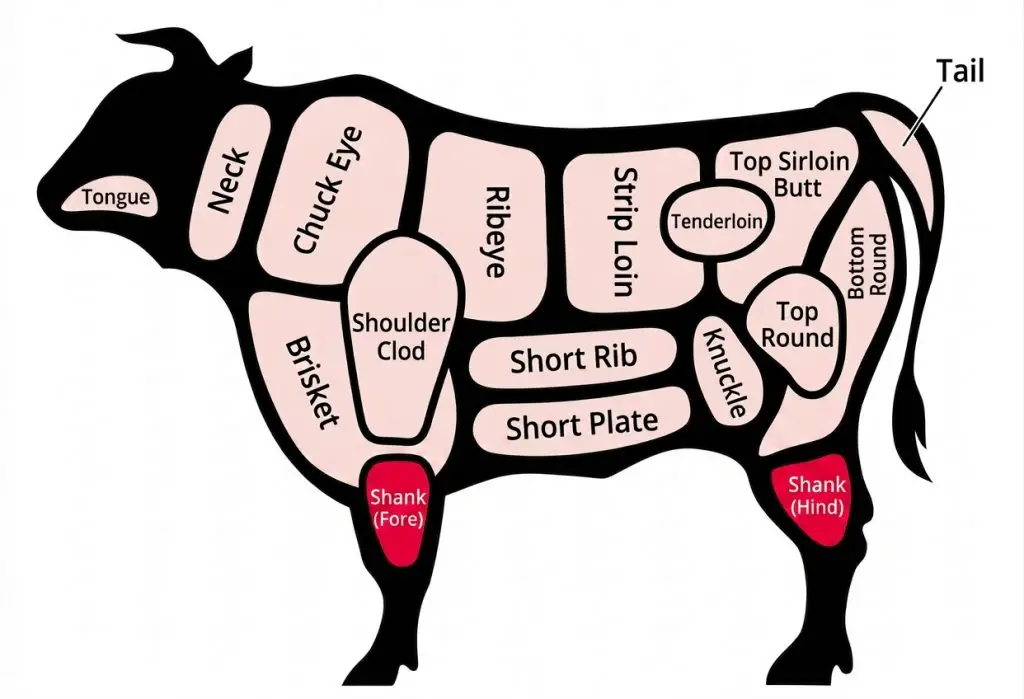
Since humans have shanks too, you probably don’t need a map for this one! True to its name, it’s the leg portion of the steer, spanning from the lower leg down to the calf muscle.
Because steers walk on four legs, we split them into the foreleg shank (“Mae-Sune” / Fore-Shank) and the hind-leg shank (“Tomo-Sune” / Hind-Shank). Structurally and culunarily, they are almost identical. A single steer yields roughly 10 kg (about 22 lbs) of this cut.
In Japanese butcher jargon, the beef shank is also beautifully referred to as “Chimaki” (named after its resemblance to traditional bamboo-wrapped rice cakes).
When people think of beef shank, the general consensus is usually: “Ugh, that meat is way too tough to eat normally!”
🛑 “I can’t chew this!” Because it bears the weight of the animal and is in constant motion, the Shank is the most highly developed muscle group in the entire steer. It contains almost zero fat, and because it is entirely lean muscle, the raw texture is exceptionally hard.
💪 Talk about being absolutely jacked!
However, while it is packed with tough membranes, silver skin, and tendons, that also means it is brimming with rich meat extracts and gelatin. Because of this unique composition, the beef shank is the ultimate “patience rewarded” cut—the longer you simmer it, the softer and more flavorful it becomes!
🫠 Melt-in-your-mouth goodness!
When slow-cooked low and slow, that initial stubborn toughness completely dissolves, transforming into a luxurious, gelatinous, melt-in-your-mouth texture.
Furthermore, because these muscles were heavily exercised, their core beef flavor and umami are incredibly concentrated. It’s a legendary base for stews, curries, and comforting soups. But here is a pro-tip: if you grind it up and blend it into burger patties or meatballs, it injects an unbelievable depth of rich, savory complexity that you can’t get from any other cut.
You might often hear about “Gyu-Suji” (Beef Tendon) in Japanese cooking—especially in winter classics like Oden or hot pots. So, what’s the difference?
Simply put, Gyu-Suji refers specifically to the Achilles tendon and the thick connective tissues attached to the ends of the leg meat. In human terms: the Shank is the actual calf muscle, while Suji is the Achilles tendon. Just like us, cows have both! For the record, the pure tendon (Suji) is even richer in pure collagen than the shank meat itself.
Because it requires slow cooking and can’t be easily flash-fried on a weekday night, the Beef Shank remains highly affordable—even when you buy it from elite, world-class Brand Wagyu varieties!
But don’t let the budget price tag fool you. As we mentioned, the Shank is an absolute umami powerhouse.
While it’s famously used for gourmet beef stews and curries, our absolute favorite recommendation at Smart is to use it for Homemade Premium Hamburg Steaks. Grind this premium Wagyu shank into a coarse mince, and you’ll create a burger packed with a deep, sweet, concentrated beefiness that no standard grocery store ground beef could ever replicate.
You might think, “Look, it’s just a minor cut, and I’m going to simmer it for hours anyway, so does the quality of the cow really matter?” The answer is a resounding YES! ❌
The baseline quality of the steer completely dictates the final product. Low-grade or poorly handled shank can turn out gamey, smelly, or stubbornly stringy.
Naturally, shanks harvested from fresh, high-quality, meticulously raised cattle are in a league of their own. Compared to imported utility beef, domestic Japanese beef is superior; and compared to standard crossbred beef, Kuroge Wagyu (Japanese Black) features vastly softer connective tissues that melt down in a fraction of the cooking time. When sourcing your meat, always choose a trusted, top-tier wholesale vendor.
At Smart, we pride ourselves on selecting only the highest tier of A5-grade “Legendary Kuroge Katsube Wagyu.” Experience the unbelievable culinary magic of restaurant-grade Wagyu right at your own dinner table!